Wednesday, October 17, 2012

Cleaning a Pentair Clean Clear Plus Cartridge Filter


How to clean a Pentair Clean & Clear Plus cartridge filterOf the three most popular filter types (DE, cartridge and sand), cartridge filters are the easiest to open and clean. written by www.WCPandS.com. This guide is meant to show others step by step how easy it is to clean their cartridge filter if they want to do it themselves.
The filter in this example is a Pentair Clean & Clear Plus filter. Other filters from major manufacturers (Hayward, Jandy, Jacuzzi, Waterway etc.) have similar steps for cleaning and will very a little.

Items needed:
- Flat head screwdriver
- Water hose connected to faucet
- Ratchet and socket or 12 point wrench or crescent wrench (a 7/8 12 point closed wrench was used in this example)

Starting:
Make sure that the pool system is off and will not turn on automatically. The easiest way to ensure this is to switch the pump breakers to the off position.

Open the air relief valve on the filter to relieve internal pressure.

Remove the band from the filter:

Note: The brass bolt many filters use to hold the band is easy to damage. Do not use pliers to remove this bolt. Use a correct sized ratchet, or crescent wrench only.

Note: Take note of the space between both ends of band. When putting the filter back together, you will want to tighten the bolt to about this same position.


There is usually a bolt, two washers, and a spring. Remove the bolt and all of the pieces on and around it.


Note: In this example, although one washer was missing, it did not affect the filter.

The band can now be removed. You may need a flat head screwdriver to pry the band off.

 It should just pull off and away from the filter.

The top section of the filter can be pulled straight up. Again, you might need a flat head screwdriver to pry the top section from the bottom. 

Note: If the filter is under pressure, it can be extremely difficult to remove the lid. If you cannot remove the lid, check to see if the air relief valve has been opened.

Note: It is possible that the filter O-ring has expanded, making the lid difficult to remove. If this is the case, more than one flat head screw driver would be needed to pry the lid off.

Removing the filters:
On top of the cartridges is a manifold. This manifold creates a seal so that water cannot enter the cartridges from their top end. This manifold is pulled straight up and off. If it seems stuck you can use the flat head screwdriver to pry it loose.


Each filter cartridge can now be pulled straight up and out. Each cartridge is exactly the same. There is no order to the placement or up/down of these so there is no need to note where each sits.

Cleaning the cartridges:
For 90% of all cartridge cleanings, they will just need to be hosed off with water. To get as much dirt and debris out as possible, a nozzle is recommended.


Note: In some cases, spraying acid directly onto the cartridge is needed to remove stains. Acid cleaning filter cartridges can be difficult to handle and is not recommended for the average person. Acid can burn skin, kill plants and corrode metal. It is better to leave acid cleanings to professionals.

Check each cartridge for holes or tares and replace the cartridge(s) if any are found.

Reinserting the cartridges and placing the top half on:
Place each cartridge back into the filter with the bottom sitting on one of the open bottom manifold openings.

Once all are back in, set the top manifold on top of all cartridges and make sure that there are no visible gaps.


The upper half of the filter can now be placed back on to the filter.

If the lid will not sit, flush with the bottom half make sure that the air relief valve is still open.

If the lid still will not sit correctly, the filter o-ring may need to be replaced. See your local swimming pool store for a replacement. They will need both the filter make and model.

Reattaching the bolt:
Place the band on and around the filter, pulling the screw though  the center of the other end. The band will not fit if the top half is not sitting down flush with the bottom half.
The order of items on the bolt should be: small washer, spring, large washer.

You can only screw on the bolt if at least a small section of the screw is visible. Once you tighten up the bolt, it will pull the screw further though. Remove the bolt and add the washers and spring.


Once the bolt is on and tightened as close to its original position as possible, the system can now be switched on (the pump).

Once the air is out of the filter, close the air relief valve and you are done.


Wednesday, October 10, 2012

Purple Pool Stains


Purple stains in pool

If you do a web search for “purple pool stains”, “pool purple ring”, or “pool purple algae,” a variety of results are displayed, each with a different reason for the purple stains. These range from high cyanuric acid, high copper levels, high magnesium levels, alkalinity problems etc., etc. I checked with our own resources and found a single reference to purple stains in the 3rd edition of the “APSP service tech manual” in chapter 8 section 28:
“Manganese produces a black-brown-purple cast and may not be noticed until extra chlorine is added or until it is necessary to raise the pH.”

Note: APSP stands for the “Association of Pool and Spa Professionals” and they are the association that produces a detailed manual covering swimming pool maintenance. Find more information here: ( APSP Website )

But I still am not 100% convinced what is causing this. We do around 100 pool/spa’s a week with little in common so we have a large example set to test what works and what does not. Just from my own experience I would guess that alkalinity/pH problems are causing the purple stains.

While the origin of these stains in pools seems to be debated among pool professionals, the method of removing them is known. The key to purple stain removal is with the use of an acidic product. Muriatic acid is the strongest form of acid available that is intended for use in swimming pools and most spas. Figuring out how to properly apply the acid safely without causing any damage can be difficult. Stains can appear on plaster, sides of vinyl, on automatic cleaners and cleaner hoses, and anywhere else at or under the water level.

Applying acid
The difficulties of this step come from the use of the acid itself. Muriatic acid will stain cement, corrode metals, burn skin, kill plants, produce a toxic cloud when expose to the atmosphere as well having other dangerous attributes. This is why I would recommend that most swimming pool owners hire a professional for any purple stain removal. Only a trained professional should attempt to handle acid. The probability of something going wrong is high when working with such a dangerous chemical for the average pool or spa owner.

Note: This is a guide of how we would handle this situation not a guide on how you should do it.

Items needed:
Muriatic acid (1 or more gallons)
A chemical sprayer (I found this one at Home Depot)

Chemical grade gloves (not gardening or dish gloves)
A scrubbing brush
A connected water hose to rinse whatever the acid is being applied to

Applying acid to an object:
There are times when only an object in the pool has a purple stain; some common objects that stain easily are automatic pool cleaners and cleaner hoses.


Note: Using acid, regardless of whether it has been diluted or not, on any object could damage or discolor it. Only a trained professional should attempt to handle acid.

When applying the acid, do not spray over dirt or concrete and remember that only a small amount of is needed (the chemical sprayer should have a mist option or mist on default).  Rinse immediately after a light spraying.

A handheld brush might be needed to get a small amount of acid spread out equally around the object.

After removing all purple stains, a swimming pool metal remover is recommended since the water was left in the pool/spa. One example of a chemical metal remover is “Metal Free,” which available from Natural Chemistry (if this was caused by a metal).
This will reduce the chance of future staining.

Applying acid to a surface:

Note: Using muriatic acid, regardless of whether it has been diluted or not, on any pool or spa surface could damage or permanently stain the surface.  Only a trained professional should attempt to handle acid.

The goal here is not to acid wash your pool/spa; it is only to remove the purple stains.
In a standard acid wash, the first step is to use just enough acid to try and gently remove the stain, leaving the pool surface intact. If that fails, a greater amount of acid is used that will essentially remove a “layer” of the surface (i.e. a layer of plaster is removed from the pool surface after being dissolved by the muriatic acid which exposes a brighter non-stained area in its place), This is why only someone with experience in applying acid should perform this step since going too far will permanently damage the surface.

The areas that have purple stains must be above the water line to be removed. Begin by draining the water down in the pool/spa. The more water drained, the better.

Only a small amount of acid is needed to remove these purple stains. Use the misting option of the sprayer.

Having a brush to scrub the area helps since it minimizes the amount of acid needed, which is good for the plaster.

Rinse the acid off with a water hose.

Repeat for all areas with purple stains.


Now refill the pool/spa.

The advantage of this procedure is replacing the water in the pool/spa. This is the most efficient method for removing or greatly reducing the amount of metals in the water and starting over with the alkalinity/pH that will reduce the chance of future staining.


And done.

Note: Again, this is a guide of how we would handle this situation not a guide on how you should do it.

Wednesday, September 5, 2012

Replacing a Pool Actuator


Replacing a Pool Actuator

Intro
A swimming pool actuator is an automated valve that is either connected to a swimming pool automation system or a solar heater system. written by www.WCPandS.com. These occasionally stop working and need to be replaced. There are versions of actuators from all of the major swimming pool parts manufactures including Jandy, Pentair, Hayward, and Intermatic and all of these are universally compatible with each other.

See the video below to watch a typical working actuator. Note its speed and smoothness.

The main reason for buying from the same manufacture is for cosmetic reasons as the top covers of the actuators are all different.
When an actuator stop moving automatically (when told to move by the automation system) or manually (from the switch on the unit) it will need to be replaced. This guide will cover removing and replacing an actuator.

In this example, we will be working with a Pentair Intelli Touch and a Pentair Compool actuator. Your setup may vary.

Note: Click on any image to see a larger version.


Getting a replacement actuator
When getting a replacement actuator, you must first decide if you want the same exact model or if you want one of the less costly models. Again, they are all cross compatible and the only major difference between them is the design of the actuator cover.  These can be purchased or ordered from most local swimming pool stores or a swimming pool online stores.

If you want the same model, write down all of the information on the old actuator or take a picture and show it to a swimming pool store sales associate.

Removing the old actuator
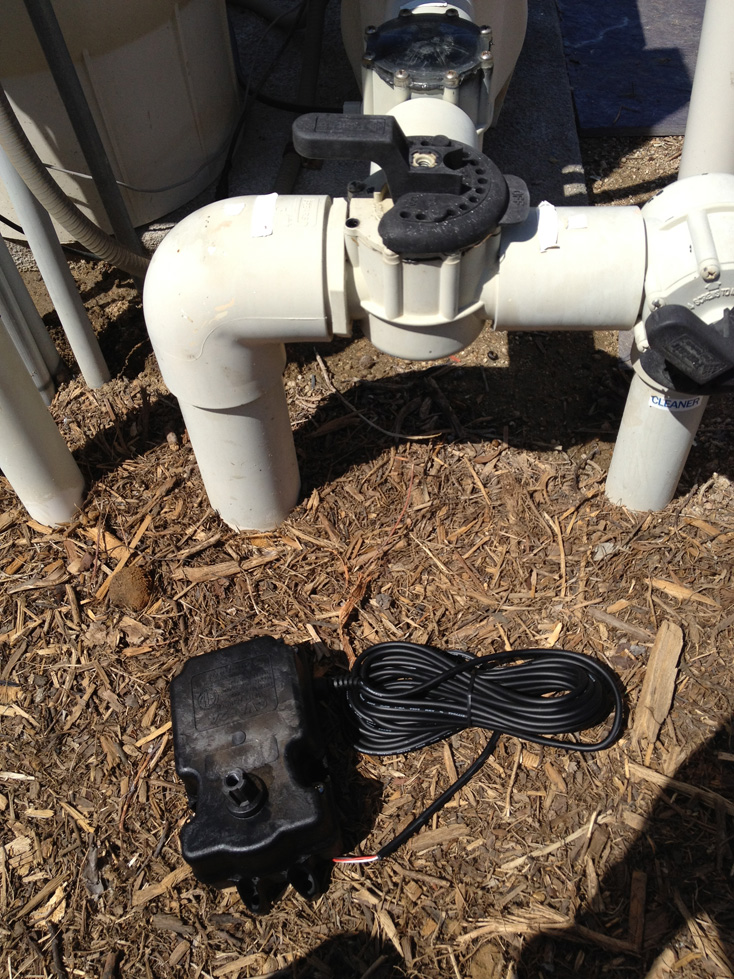
Locate the broken actuator; it is held in place by four screws and one plastic screw on the top of the handle. It is not uncommon for the top plastic screw to be missing. If this is the case, do not worry as this will not adversely affect the valve in any way.

Remove the top plastic screw. The plastic handle it was over can now be pulled straight up and off.


Remove the 4 visible screws that hold in the actuator with a Phillips head screw driver.
The actuator can now be pulled straight up and off.

Follow the cable from the back of the actuator to the controller it is plugged into. If the cable is tie wrapped anywhere, carefully cut these to free the wires.

If this actuator is connected to an automated control system, it will be plugged in to the circuit board. This will require you to remove the cover panel(s) of the controller to get to this connection.


Note: If this is for a solar controller, it could be connected by being directly plugged into a controller board or in some cases the cable end may have been spliced. If your cable has been spliced, take a picture of the connections before removing them so you will know how to reconnect the wires of the new unit.

Most systems will have the plug-in slot marked on the board “Actuator.”

Installing the new actuator
The new actuator will be installed by reversing the steps of the removal. Start by connecting the new cable end into the controller box and up to the controller board.

Plug the cable end into the board.

Leave the cover of the panel open. At the end of the installation, the extra cable will be pushed into this panel.


Before placing the new actuator onto the valve, the valve will need to be turned to fit the new actuator position. To find this, place the plastic handle on the new actuator. Now, take note of the valve handle position.


Place the handle on the valve and turn the valve to the same direction the actuator is already set in.


Remove the plastic handle and place the new actuator over the valve.

Screw in the 4 bolts to secure the actuator in place.


Place the handle over the new actuator and screw in the plastic screw to the top.


You can now tie wrap the loose cable up off the ground and pull the extra cable into the control panel (if there is a space for it).

Setting the actuator position
The actuator position will now need to be checked and changed if needed. Automated pool systems assume the automated valves are set in “Pool Mode” by default. To change the actuator position manually, there is a switch either on the back or under actuator. Just move the switch to the opposite of what it currently is to move the actuator. See the picture below from behind this actuator.
If you need to manually shut off an actuator, set this toggle switch to its middle position. You will want to do this when a valve needs to stay in one position, for example, to keep a malfunctioning valve from moving.
Since there is no standard system setup, valve positions vary from pool to pool.  If you need afew examples of valve position, see our write up here.